


Sometimes the most incredible stories hide in plain sight. During our private tour of Château de Gizeux in France’s Loire Valley, we discovered how clever villagers built false walls to protect Renaissance masterpieces during the French Revolution. What we learned reveals not just an amazing survival story, but why this particular château holds secrets that will take your breath away.
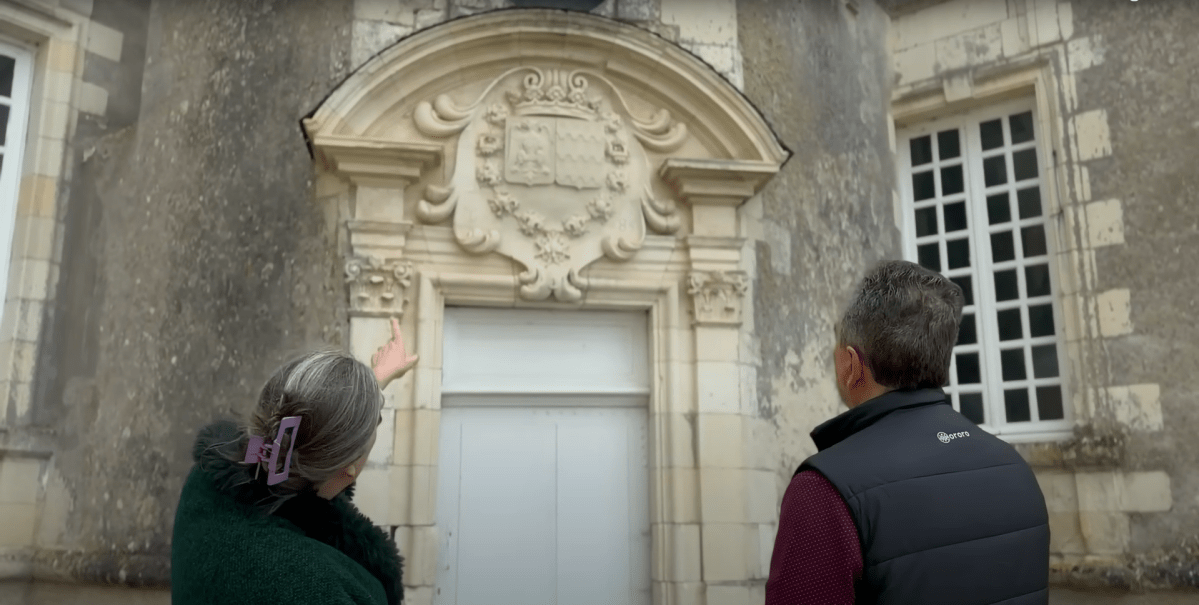
Château de Gizeux is something truly extraordinary. It’s a Renaissance château built in 1560 that stretches an incredible 250 meters in length, making it the longest inhabited château in western Touraine. What makes the chateau even more remarkable is that it contains France’s largest privately-owned collection of Renaissance frescoes, preserved through over 450 years of continuous noble family residence.
Standing before this magnificent building, you’re looking at living French history. The château earned its Monument Historique designation in 1862, recognizing its exceptional cultural value. Located in the heart of the Loire Valley’s Centre-Val de Loire region, it represents the perfect fusion of medieval foundations with Renaissance elegance.
But the real magic lies in what happened here during the darkest period of the French Revolution… and how ordinary people risked everything to save extraordinary art.
A Family's Love Story Spanning Centuries
When we arrived at Château de Gizeux, we were welcomed by Stéphanie Desfontaines, whose husband’s family has called this remarkable place home since 1786. Think about that for a moment – that’s before the French Revolution, over 240 years of unbroken family stewardship through revolutions, wars, and countless social changes.
The Desfontaines family received the château as a wedding gift in 1786, and they’ve never let it go. Through the Terror of the French Revolution (1792-1794), both World Wars, and all the challenges of modern preservation, this family has maintained continuous residence. Unlike châteaux that passed through multiple owners or fell into ruin, Gizeux has preserved not just its architecture but its stories, its secrets, and its soul.
Standing in their entrance hall, surrounded by centuries of family crests and accumulated memories, we realized we weren’t just visiting another tourist attraction. We were guests in a living piece of French heritage, protected by generations of dedication and love.
Watch Our Viral Discovery at Château de Gizeux
Join us on this incredible private tour as Stéphanie reveals the secrets her family has protected for centuries, including the amazing story of how false walls saved Renaissance masterpieces. This episode has been viewed over 700,000 times and continues growing as château lovers around the world discover this remarkable preservation story.
The Princess Who Commissioned a Masterpiece

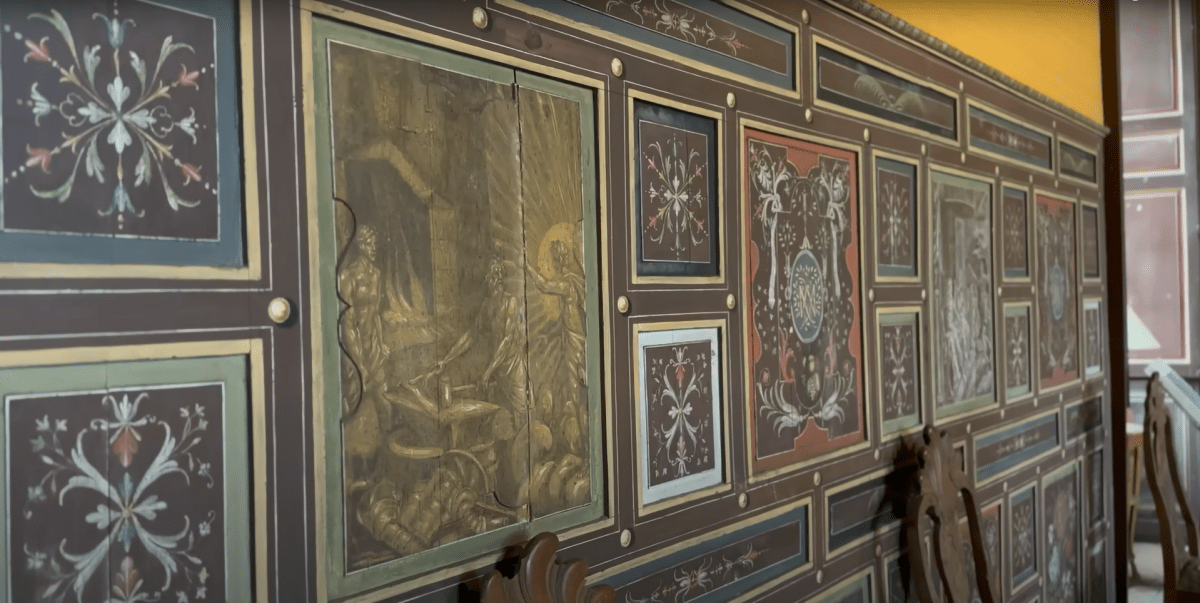
The story of the hidden art begins with Marie d’Yvetot, a Norman princess who married into the prestigious du Bellay family during the height of the French Renaissance. In 1585, Marie decided she wanted to live like true royalty, so she commissioned Italian Renaissance masters to transform an entire room into a magnificent gallery.
These weren’t just any artists. They were skilled professionals who created elaborate frescoes covering every surface with scenes from Ovid’s Metamorphoses, the classical mythology that educated Renaissance nobles were expected to know. But Marie was clever about showing off her family’s wealth in the most elegant way possible.
Look closely at the paintings, and you’ll notice tulips everywhere. Dozens and dozens of them worked into every decorative scene. During the Renaissance, tulips were extraordinarily rare in France, more valuable than gold. A single tulip bulb could cost more than a skilled craftsman earned in an entire year. By filling her gallery with painted tulips, Marie was essentially wallpapering her room with symbols of extreme wealth, but doing it so beautifully that guests would admire the artistry while understanding the message.
The Italian artists used sophisticated “trompe l’oeil” techniques, creating optical illusions that make you feel like you’re standing in the center of a garden no matter where you are in the room [Britannica, 2025]. It’s like the eyes of the Mona Lisa following you, but applied to entire wall compositions of mythological scenes and landscape gardens.
When Revolution Threatened Everything Beautiful
When the French Revolution erupted in 1789, everything changed for noble families like the du Bellays. By 1792, revolutionary forces were systematically targeting symbols of aristocratic excess throughout France [Paris Musees, 2025]. They weren’t just after people. They wanted to destroy the culture, the art, the very symbols of the old nobility.
At Château de Gizeux, the revolutionaries arrived and did exactly what they did everywhere else. They systematically destroyed the painted rooms in the medieval section of the château, smashing elaborate decorations and anything that represented the wealth and power of the old regime. Room after room of beautiful art was lost forever.
Marie d’Yvetot’s magnificent Renaissance gallery should have suffered the same fate. The revolutionaries were thorough, they were organized, and they knew exactly what to look for. These stunning frescoes, with their obvious displays of aristocratic luxury, would have been prime targets for destruction.
But then something miraculous happened that would preserve this art for centuries.
The Brave Plan That Saved Everything
A young woman living in the château during the Revolution watched the destruction happening in other parts of the building and realized the Renaissance gallery would be next. She had to act quickly. History hasn’t preserved her name, but her courage saved irreplaceable cultural heritage.
Her solution was brilliant in its simplicity. She approached the local villagers of Gizeux for help. These weren’t wealthy aristocrats or art experts, but ordinary working people who understood that something beautiful was about to be lost forever. They agreed to help, knowing they were taking enormous personal risks during the most dangerous period of the Revolution.
Working quickly and quietly, the villagers helped build false walls and false ceilings over the entire painted gallery. They created a completely plain, undecorated room that looked boring and worthless to revolutionary eyes. When the revolutionaries returned to inspect this area, they saw nothing worth destroying and moved on.
The plan worked perfectly. Behind those false walls, Marie d’Yvetot’s Renaissance masterpiece went to sleep, protected in complete darkness while the Revolution raged around it.

A Century of Perfect Preservation
For nearly 100 years after the Revolution, those false walls remained in place. The Renaissance gallery slept in complete darkness, its colors protected from light, moisture, and damage. The preservation was so complete that when the art was finally rediscovered, it looked exactly as it had on the day it was hidden.
What makes this even more remarkable is how well the family kept the secret. The knowledge of what lay behind those walls passed from generation to generation, but over time, the specific details grew fuzzy. Older family members would hint at “something special” hidden in that part of the château, but the exact nature of the treasure had become more family legend than family fact.
For an entire century, one of France’s most spectacular Renaissance art collections remained hidden in plain sight, waiting for the right moment to be revealed again.
A Boy's Accidental Discovery Changes Everything
At the end of the 19th century, Stéphanie’s husband’s great-grandfather was just a little boy playing in the vast halls of Château de Gizeux. Like children in old châteaux everywhere, he found ways to get into harmless mischief, exploring every corner of his family’s enormous home.
While playing near those mysterious plain walls that had protected the Renaissance art for decades, he accidentally made a small hole in the false wall. Through that tiny opening, he glimpsed something that would change his family’s understanding of their own heritage forever: brilliant, vibrant colors that had been hidden in darkness for nearly a century.
That accidental discovery by a curious child led to one of the most exciting moments in the château’s long history. When the family finally removed the false walls and ceilings, they found the Renaissance paintings in absolutely perfect condition. The colors were as vibrant as the day they were painted over 400 years ago – no fading, no damage, no deterioration whatsoever.
The false walls hadn’t just hidden the paintings; they had created the perfect preservation environment. Protected from light, moisture, and temperature changes for 100 years, the artwork had essentially been in suspended animation, waiting for its moment to dazzle the world again.
An Art School Preserved on the Walls

Our tour revealed another incredible treasure that makes Gizeux unique among French châteaux. In addition to the hidden Renaissance gallery, the château houses what may be France’s most comprehensive documentation of how art was taught in the 17th century.
Between 1680 and 1690, the château’s owner invited an entire art school to live and work at Gizeux. A master painter brought his students to use the château’s walls as their canvas and classroom, creating over 400 square meters of instructional artwork that still exists today.
Walking through these galleries is like having access to a 17th-century art school’s complete curriculum preserved in paint. You can literally see students learning as you move from wall to wall. Some paintings show hesitant, beginner-level work, while others demonstrate master-level skill and technique.
The teaching methods are fascinating to observe. In one hunting scene, the master painted the first dog as a perfect example, then students copied it as accurately as they could. You can see how their versions become less precise as they struggled to match their teacher’s skill. Some students specialized in landscapes and trees, others focused on animals, and still others concentrated on architectural details and human figures.
The students practiced scaling up small printed engravings to massive wall paintings, learning proportion and perspective on an enormous scale. The most amusing paintings show famous châteaux like Chambord and Versailles, but not as they actually looked. These were teaching exercises where students learned technique from small illustrations, often adding imaginative elements like mountains behind Chambord (which actually sits on perfectly flat land).
This collection represents the only known intact residential art school documentation from 17th-century France, providing irreplaceable evidence of how artistic skills were transmitted before formal art academies existed. University of Tours researchers have confirmed this assessment, noting that no comparable educational art collection survives anywhere else in France.
The Reality of Preserving a Living Treasure
During our private tour, Stéphanie was refreshingly honest about what it actually takes to maintain a château like Gizeux in the modern world. Behind all the beauty and history lies an enormous commitment that most people never consider.
The numbers tell the story: 1,000 hectares of estate lands (mostly ancient forest), 2 hectares of roof surface requiring constant maintenance, and 12,000 visitors annually who help fund preservation efforts. The Desfontaines family has managed this responsibility for 240 years, often making personal sacrifices to ensure their château’s survival.
“It’s really too big for us,” Stéphanie told us honestly. Parts of the medieval château have been uninhabitable for decades. A major storm destroyed sections of roofing, rain damage has rotted floors, and entire areas are now too dangerous to enter. But the family never gives up.
They installed a temporary roof system that should last 20 years, stopping further deterioration while they work toward more permanent solutions. Every repair decision must balance the family’s daily living needs with their responsibility to preserve French cultural heritage for future generations. The annual preservation costs often exceed what most families earn in a year, yet these represent the minimum investment required to prevent deterioration.
Like many château families, the Desfontaines open their private home to thousands of visitors each year to help fund preservation efforts. This means sharing their most intimate family spaces with strangers, managing complex tourism logistics, and maintaining museum-quality presentation standards while actually living in these historic rooms.
Yet this sharing creates something beautiful. Visitors form deep emotional connections with these properties and the families who preserve them, creating a global community of people invested in château preservation. The overwhelming response to our YouTube series demonstrates this perfectly – viewers from around the world feel personally connected to this family’s preservation story and want to support their efforts.
Why This Castle Story Matters for Cultural Heritage
The false walls of this French castle represent something profound about preservation, survival, and the power of community action to protect cultural heritage during times of crisis.
Without that unnamed young woman’s quick thinking and the villagers’ courage, these Renaissance castle paintings would have been destroyed like so many others during the Revolution. Today, they’re among the best-preserved Renaissance interiors in France, offering a window into 16th-century aristocratic castle life that exists virtually nowhere else.
The castle story demonstrates how ordinary people, not wealthy patrons or government institutions, can make the difference between preservation and destruction. Those villagers of Gizeux understood that beauty and history have value worth protecting, even at personal risk during the most dangerous period in French history.
The Desfontaines family’s 240-year commitment ensures these castle stories and artworks survive for future generations. Their willingness to share their castle home with visitors means people worldwide can experience this remarkable castle and understand the human cost of cultural preservation.
Our experience at Gizeux taught us that every château holds hidden stories waiting to be discovered. Sometimes they’re literally hidden behind false walls, sometimes they’re hiding in plain sight, waiting for someone curious enough to ask the right questions and listen carefully to the answers.
FAQ: Planning Your Own Discovery at Gizeux
If our story has inspired you to experience Château de Gizeux yourself, here’s what you need to know for the most meaningful visit possible.
How long should you plan for a visit?
A complete tour of Château de Gizeux requires 90 minutes to 2 hours, depending on your interest in historical details. The guided tour covers 12 furnished rooms including the Renaissance gallery and art school frescoes, plus access to the gardens and grounds. Family visits typically take about 75 minutes with interactive elements designed for children.
What makes this castle different from other Loire Valley castles?
Three things set this French castle apart: the continuous family residence spanning 240+ years, France’s largest collection of privately-owned Renaissance frescoes, and intimate access to furnished family apartments that most castles simply can’t provide. The false wall preservation story is completely unique among French castles.
When is the best time to visit this castle?
This Loire Valley castle welcomes about 12,000 visitors annually for guided tours from April through October. Spring visits (April-May) offer beautiful castle garden settings with fewer crowds, while summer provides extended hours and special castle exhibitions. The peak season offers the most comprehensive access to all castle rooms and stories.
What will you experience at this castle?
Your castle visit includes the complete Renaissance gallery with its 400-year-old paintings in pristine condition, the remarkable art school collection showing 17th-century teaching methods, personal stories of family preservation across nearly two and a half centuries, and clear evidence of how castles evolved from medieval fortresses to Renaissance palaces.
By visiting French castles like this one, you directly support castle preservation and ensure these remarkable stories continue reaching future generations. Every entrance fee contributes to the enormous ongoing costs of maintaining these irreplaceable castle properties while supporting the families who dedicate their lives to castle preservation.
Your visit also becomes part of the château’s continuing story, connecting you to a global community of people who share fascination with French heritage and the remarkable families who preserve it against all odds.

The Enduring Magic of Authentic Discovery
Our experience at Château de Gizeux perfectly captures why we fell in love with château exploration during our 6 months living in France. These aren’t just beautiful buildings or historical artifacts, they’re living repositories of human creativity, ingenuity, and dedication spanning centuries.
The false walls that protected Renaissance art for 100 years represent the ongoing dialogue between preservation and survival that defines château stewardship. Understanding this dialogue helps us appreciate not just what these properties once were, but what they continue to become through the dedication of families like the Desfontaines.
Most importantly, their willingness to share these stories with visitors like us, and through our videos with viewers around the world, ensures that these remarkable tales of preservation and survival continue inspiring new generations of château lovers.
Sometimes the most incredible discoveries really are hiding in plain sight, waiting for curious hearts and the courage to ask, “What’s the story behind this wall?” At Château de Gizeux, that question led to one of the most beautiful preservation stories we’ve ever encountered.
The walls may have been false, but the courage, creativity, and commitment they represented were absolutely, powerfully real.
Watch our complete Château de Gizeux discovery in our viral YouTube series with over 700,000 views, and subscribe to join us on more authentic château adventures throughout France’s Loire Valley. What hidden château story should we uncover next?
This article is based on our private tour with Stéphanie Desfontaines in January 2025, family historical records, Archives Départementales d’Indre-et-Loire documentation, official Monument Historique designation files, and on-site château research throughout France’s Loire Valley region.


