

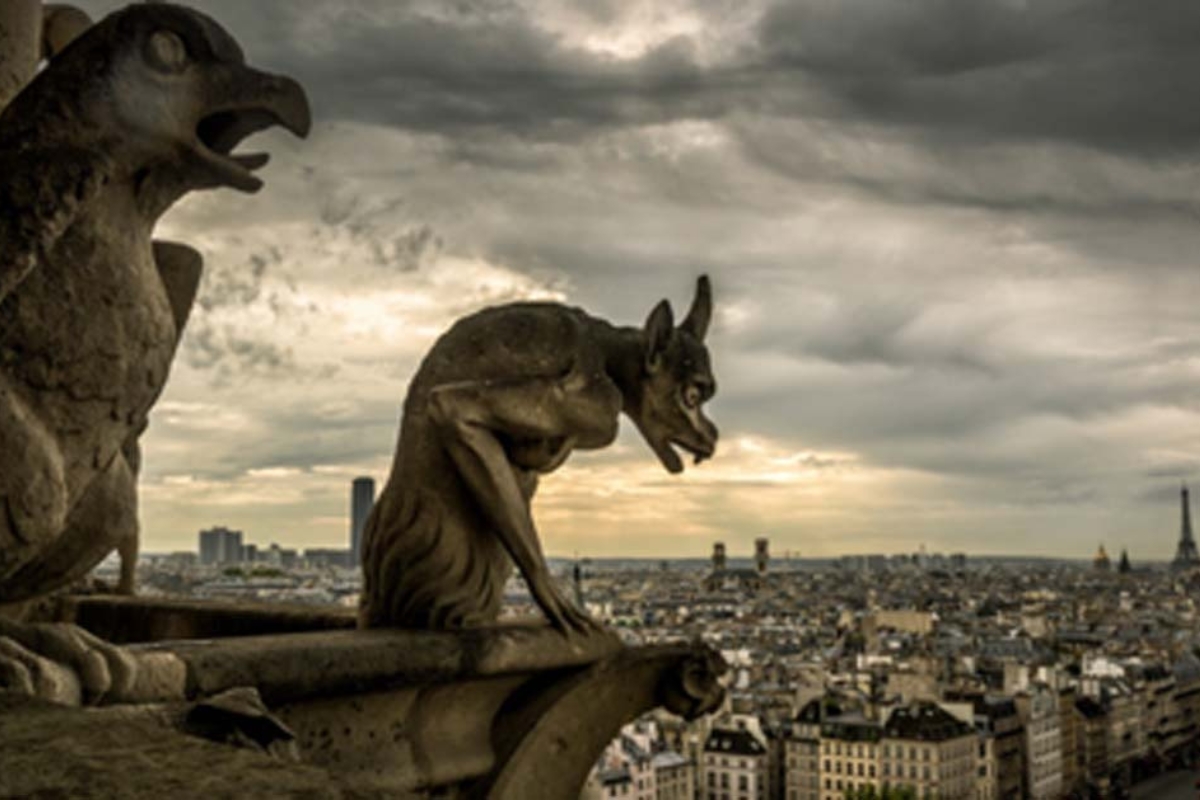
As the autumn mist swirls around the ancient stone spires of a Gothic cathedral, your eyes are drawn upward. There, perched high above the ground, frozen in eternal vigilance, are faces that could have sprung from the darkest of nightmares. Snarling beasts with elongated necks, winged creatures with human faces, and twisted humanoid forms peer down at you from every corner and crevice. Welcome to the world of medieval gargoyles and grotesques, where monsters lurk in plain sight and stone comes alive with secrets of the past.
Whispers in Stone: The Birth of Guardians
Picture yourself in 12th century France. The air is thick with the dust of construction as a new cathedral rises towards the heavens. Among the bustling workers and devout clergy, a group of stone carvers huddle around crude sketches. Their task? To bring to life creatures that will guard this holy place for centuries to come.
But these artisans aren’t starting from scratch. Their craft is built upon a legacy stretching back to ancient Egypt, where fierce lion heads spouted water from temple roofs, protecting the structures from erosion. In Greece, hideous faces adorned roof tiles, their ugliness believed to ward off evil spirits. The Romans continued this tradition, with theatrical masks and mythological creatures gracing their buildings.
Now, in the heart of medieval Europe, these ancient traditions are about to evolve into something uniquely haunting. The rise of Gothic architecture, with its soaring spires and flying buttresses, provides the perfect canvas for a new generation of stone guardians.
More Than Meets the Eye: The Dual Nature of Stone Sentinels
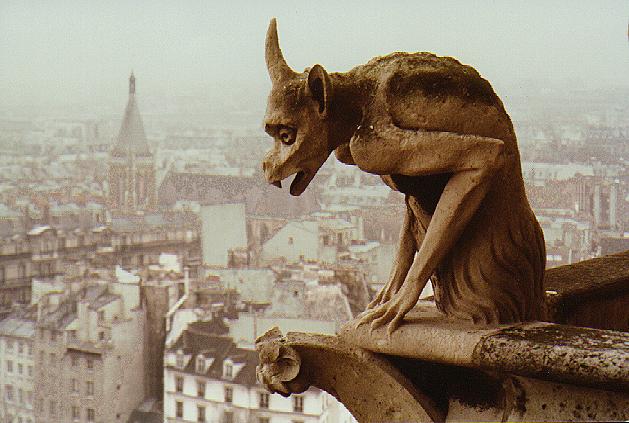
As our cathedral grows, so do its guardians. High above the ground, long-necked creatures begin to take shape. These are the true gargoyles, their open mouths not frozen in screams, but designed to channel rainwater away from the building’s foundations. The word “gargoyle” itself comes from the French “gargouille,” meaning “throat” or “gullet,” a nod to their water-spouting function.
Imagine the ingenuity of these medieval architects and stonemasons. In an age before advanced plumbing, they created a system of water drainage that was both functional and fearsome. The long necks of the gargoyles projected the water far from the walls, preventing erosion of the mortar between stones. Their frightening appearance served a dual purpose: to strike fear into the hearts of sinners and to remind the faithful of the ever-present danger of straying from the path of righteousness.
But look closer, and you’ll see they’re not alone. Nestled in niches, perched on ledges, and peering out from dark corners are their cousins – the grotesques. These figures serve no practical purpose beyond their imposing presence. The term “grotesque” comes from the Italian “grottesco,” referring to the ancient Roman murals discovered in underground caves or “grottos.” Unlike gargoyles, grotesques don’t spout water. They are purely decorative and symbolic, their contorted forms a stark contrast to the serene saints and angels that also adorn the cathedral.
Stories Set in Stone: The Language of Symbols
As night falls and the cathedral is bathed in moonlight, imagine the stories these stone figures could tell. Each carving is a message, a lesson, a warning etched in rock.
There, a demon wrestles with an angel – the eternal struggle between good and evil made manifest. This common motif serves as a vivid reminder of the spiritual warfare believed to be constantly raging around and within each person. Nearby, a man’s face contorts with greed, his mouth stretched wide in an eternal scream of avarice – a stark reminder of the seven deadly sins and their consequences.
Look to your left, and you might spot a pelican pecking at its own breast. This peculiar image represents self-sacrifice, based on the medieval belief that pelicans fed their young with their own blood in times of famine. It’s a symbol of Christ’s sacrifice, hidden in the form of a grotesque.
High above, barely visible in the gloom, a gentle saint offers a benediction to all who enter. This juxtaposition of the monstrous and the divine is no accident. In medieval Christian theology, even the most hideous creatures had a place in God’s creation, serving as a reminder of the fall from grace and the ever-present need for redemption.
These are more than mere decorations. In an age when few could read, these carvings were a Bible in stone, teaching morality and striking fear into the hearts of sinners. The faithful could “read” these images, understanding complex theological concepts through visual storytelling.
Some even whisper that the grotesques serve a more mystical purpose – their hideous visages thought to ward off evil spirits, fighting fire with fire in a world where the supernatural lurked around every corner. This concept, known as apotropaic magic, suggests that these frightening figures could scare away demons and dark forces, protecting the sacred space within.
Guardians Through the Ages: From Notre-Dame to Gotham City
As centuries pass, our cathedral’s guardians watch silently. They witness coronations and revolutions, wars and peacetime, standing steadfast through it all.
In Paris, the gargoyles of Notre-Dame become world-famous, their enigmatic grins capturing the imagination of millions. Victor Hugo’s hunchback, Quasimodo, finds solace among them in “The Hunchback of Notre-Dame” (1831). Hugo’s vivid descriptions brought these stone creatures to life in the public imagination:
“What a fresco of deformities upon a bronze background! What a fantastic symphony of the grotesque! And in all this neither confusion nor lack of unity: a ghostly, fantastic, yet harmonious whole.”
The gargoyles of Notre-Dame have endured much. During the French Revolution, many were destroyed, seen as symbols of the oppressive monarchy and church. In the 19th century, during a major restoration led by Eugène Viollet-le-Duc, many were recreated or newly invented, blending medieval and Victorian Gothic sensibilities.
Across the channel, Oxford University’s grotesques take on a scholarly air, their monstrous faces a stark contrast to the erudite discussions below. The “Emperor Heads” outside the Sheldonian Theatre, carved by William Byrd in the 1660s, are particularly famous. These grotesques, with their exaggerated expressions and exotic headgear, are thought to represent the world’s diversity and the breadth of knowledge pursued within the university’s walls.
In Germany, the Cologne Cathedral boasts an array of gargoyles that seem to defy gravity, their elongated forms stretching out into space. Among them, modern additions like a gargoyle in the form of a cameraman remind us that this tradition is far from dead.
And in the New World, Eastern State Penitentiary in Philadelphia proves that even modern buildings can benefit from these medieval guardians. Built in the 1820s, its Gothic Revival architecture includes gargoyles that serve as a haunting reminder of justice and punishment. These American gargoyles, with their stern, judgmental expressions, speak to the building’s purpose as a place of penance and reformation.

The Artisans Behind the Monsters: Crafting Nightmares
But let’s not forget the human hands that brought these creatures to life. Imagine the medieval stonemason, perched precariously on wooden scaffolding, his chisel poised against the unyielding stone. Each strike must be precise, for one slip could ruin weeks of work.
These artisans were more than mere laborers. They were artists, theologians, and storytellers rolled into one. Many left their mark literally, carving tiny signatures into their creations – a secret hello echoing through the ages. These “Mason’s Marks” can still be found on many medieval buildings, a personal touch hidden among the grand designs.
The creation of a gargoyle or grotesque was a painstaking process. It began with a sketch, often based on descriptions from bestiaries – medieval catalogues of beasts both real and imaginary. The stonemason would then create a clay model to refine the design before finally tackling the stone itself.
The tools of their trade were simple but effective: mallets, chisels, and gouges of various sizes. With these basic implements, they could transform rough blocks of limestone or sandstone into intricate works of art. The work was dangerous and physically demanding. Many stonemasons suffered from silicosis, a lung disease caused by inhaling stone dust, giving a grim double meaning to the phrase “leaving your mark on history.”

From Cathedral to Pop Culture: The Enduring Legacy
As we return to the present, the influence of these stone guardians is everywhere. Gothic revival architecture brought them back into vogue in the 19th century. Today, they peer down from city halls, universities, and even apartment buildings.
In literature and film, gargoyles have taken on a life of their own. They swoop through the night sky in animated series like Disney’s “Gargoyles” (1994-1997), where the stone creatures awaken at night to protect modern-day New York City. In the world of comics, Batman’s Gotham City is watched over by grotesques and gargoyles, providing perfect perches for the Dark Knight as he surveys his domain.
Authors have long been fascinated by the idea of stone coming to life. In Terry Pratchett’s “Feet of Clay” (1996), the gargoyles of Ankh-Morpork are living creatures, serving as watchmen with infinite patience. In Mervyn Peake’s “Gormenghast” series, the castle itself seems alive with grotesques, blurring the line between architecture and character.
Even in the world of video games, gargoyles have found a home. The “Dark Souls” series features fearsome stone dragons and demons that blur the line between architecture and enemy, while “Assassin’s Creed: Unity” allows players to climb the faithfully recreated gargoyles of Notre-Dame.
The Guardians Among Us
Next time you walk down a city street, take a moment to look up. You might be surprised by what’s looking back at you. The legacy of medieval gargoyles and grotesques lives on, a reminder that sometimes the most enduring stories are those carved in stone.
In New York City, the Chrysler Building’s eagle gargoyles watch over the bustling streets below, Art Deco reinterpretations of their medieval forebears. In Barcelona, Gaudí’s fantastical creations blur the line between architecture and sculpture, his grotesques seeming to grow organically from the facades of his buildings.
These silent guardians, born in an age of superstition and faith, continue to captivate us. They stand as testament to human creativity, to our need to explain the inexplicable, and to the power of art to transcend time. In their twisted forms, we see reflections of our own fears and aspirations, reminders of the thin line between the monstrous and the divine.
In a world of constant change, there’s something comforting about these unchanging faces. They’ve watched over us for centuries, bearing witness to the ebb and flow of history. If we preserve them, they’ll continue their vigilant watch for centuries to come, whispering secrets of the past to all who care to listen.


